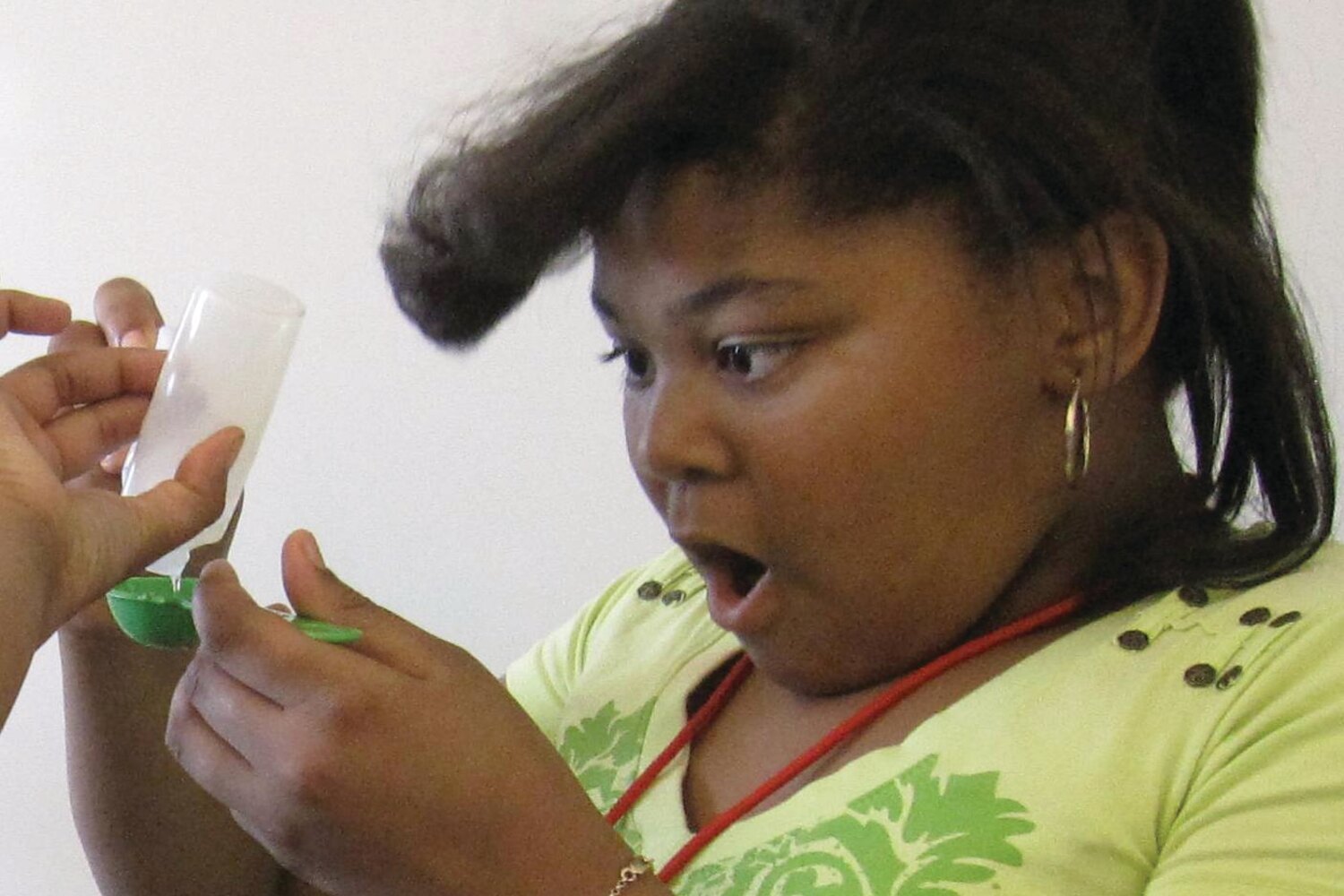
Imagine walking into a room full of young students deeply focused on creating the ultimate sports beverage. They aren't just mixing solutions together, they're real-world flavor scientists! At a Techbridge Girls event, students are tasked with a fun, hands-on challenge: designing, mixing, and naming their very own custom sports drinks. They choose a base like water, milk, or coconut water, add electrolytes and flavorings, then put their concoctions to the test by analyzing pH, glucose, and electrolyte levels. After all the chemistry is done, they pitch their creations in a taste test to see which formula is the healthiest and the most delicious.
This dynamic activity is messy. It's experimental. And it's deeply, unapologetically creative, which is exactly what great STEM education should look like. Whether it's designing a custom sports beverage or an energy-efficient transportation system, creative problem-solving is at the heart of STEM disciplines. It's the secret sauce that drives innovation.
Real STEM, the kind that drives actual breakthroughs, runs on a disciplined creativity that generates ideas that are original, useful, and elegant.
It starts with free-flowing divergent thinking — brainstorming widely, chasing unconventional possibilities, refusing to self-edit. Then comes the methodical, evaluative work of convergent thinking — sifting through those ideas to find the one that best fits the real-world constraints. Together, these two modes of thinking form the foundation of STEM disciplines.
Cracking the Impossible
Calcea Johnson and Ne'Kiya Jackson are a perfect example of this creative problem-solving in action. These two brilliant Black high school students from St. Mary's Academy in New Orleans took on a challenge from their math teacher, who offered a $500 incentive to anyone who could prove the Pythagorean Theorem using trigonometry.
For 2,000 years, experts thought this was an impossible feat. But Calcea and Ne'Kiya ignored the limits of the past and created a groundbreaking trigonometric proof they dubbed the "Waffle Cone." By drawing congruent right triangles extending into infinity, they formed a larger cone shape and cracked the problem wide open. Their achievement in joining an exclusive club with only one other trigonometric proof on record, documented in 2009, proves that math isn't just about memorizing what's in a textbook. It's about visualizing new patterns, playing with concepts, and trying combinations until something clicks. It is, at its core, a creative endeavor.
Where Creativity Takes Root
So where do we cultivate this kind of thinking? Formal classrooms are essential, but out-of-school and after-school programs are absolute game-changers for fostering creativity. Informal learning environments give students, especially those who are left out of traditional STEM spaces, the freedom to just be. No grades looming overhead, no pressure to perform. Just room to experiment, fail safely, and stumble into those electric "aha!" moments that make learning stick.
The beauty of out-of-school learning is that its benefits spill directly back into the traditional classroom. When youth experience a creative breakthrough in an after-school program, they bring that unshakeable confidence right back to their regular school day. In fact, a groundbreaking 26-year longitudinal study released in 2025 found that consistent participation in after-school programs predicts better grades, improved social skills, stronger peer relationships, and higher math and reading scores. For older students, these gains translate into engaging in more challenging coursework.
At Techbridge Girls, we've been championing this kind of joyful, rigorous, creative out-of-school learning for 25 years. By building spaces where students can safely experiment, fail, and succeed, we're preparing youth to be confident, capable, and curious. Our participants are more likely to take advanced placement math courses and graduate at twice the rate of their peers.
What Comes Next
We're now expanding into Artificial Intelligence and Data Science, fields that will define the future. We're preparing students to creatively tackle real-world community issues like urban housing, clean water, food access, and environmental justice using large data sets and AI tools. By applying our successful programming approach to these new fields, we are influencing how these subjects are taught, learned, and used. We are making sure a diversity of voices are prepared to thoughtfully, collaboratively, intentionally build what comes next.
Every scientific discovery, every engineering marvel, every elegant equation started with someone asking "what if?" Chemistry is creative. Coding is creative. Math, as Calcea and Ne'Kiya so brilliantly proved, is deeply creative. The best scientists and engineers aren't just number-crunchers and technicians. They're imaginative thinkers and tinkerers who happen to work with data, code, formulae, and formulations as their medium.
That's not a coincidence. That's what happens when you treat creativity not as a nice-to-have, but as the whole point.
Whether they're balancing the pH of a homemade sports drink or flipping trigonometry on its head, students thrive when given the freedom to play, imagine, and create. And the numbers back it up: 90% of Techbridge Girls participants report feeling more confident in their STEM knowledge.
So let's keep mixing, testing, and dreaming big!